Saturday, September 17, 2022

4b. Fodor, J. (1999) "Why, why, does everyone go on so about thebrain?"

Fodor, J. (1999) "Why, why, does everyone go on so about thebrain?" London Review of Books21(19) 68-69. 

I once gave a (perfectly awful) cognitive science lecture at a major centre for brain imaging research. The main project there, as best I could tell, was to provide subjects with some or other experimental tasks to do and take pictures of their brains while they did them. The lecture was followed by the usual mildly boozy dinner, over which professional inhibitions relaxed a bit. I kept asking, as politely as I could manage, how the neuroscientists decided which experimental tasks it would be interesting to make brain maps for. I kept getting the impression that they didn’t much care. Their idea was apparently that experimental data are, ipso facto, a good thing; and that experimental data about when and where the brain lights up are, ipso facto, a better thing than most. I guess I must have been unsubtle in pressing my question because, at a pause in the conversation, one of my hosts rounded on me. ‘You think we’re wasting our time, don’t you?’ he asked. I admit, I didn’t know quite what to say. I’ve been wondering about it ever since.


See also:

Harnad, S. (2019). Can neuroimaging reveal how the brain thinks? In Casting Light on the Dark Side of Brain Imaging (pp. 9-11). Academic Press.

Grill-Spector, K., & Weiner, K. S. (2014). The functional architecture of the ventral temporal cortex and its role in categorization. Nature Reviews Neuroscience, 15(8), 536-548.

ABSTRACT: Visual categorization is thought to occur in the human ventral temporal cortex (VTC), but how this categorization is achieved is still largely unknown. In this Review, we consider the computations and representations that are necessary for categorization and examine how the microanatomical and macroanatomical layout of the VTC might optimize them to achieve rapid and flexible visual categorization. We propose that efficient categorization is achieved by organizing representations in a nested spatial hierarchy in the VTC. This spatial hierarchy serves as a neural infrastructure for the representational hierarchy of visual information in the VTC and thereby enables flexible access to category information at several levels of abstraction.


Friday, September 16, 2022

5. Harnad, S. (2003) The Symbol Grounding Problem

Harnad, S. (2003) The Symbol Grounding Problem. Encylopedia of Cognitive Science. Nature Publishing Group. Macmillan.   

or:

Harnad, S. (1990). The symbol grounding problem. Physica D: Nonlinear Phenomena, 42(1), 335-346.

or:

https://en.wikipedia.org/wiki/Symbol_grounding

The Symbol Grounding Problem is related to the problem of how words get their meanings, and of what meanings are. The problem of meaning is in turn related to the problem of consciousness, or how it is that mental states are meaningful.


 If you can't think of anything to skywrite, this might give you some ideas: 
Taddeo, M., & Floridi, L. (2005). Solving the symbol grounding problem: a critical review of fifteen years of research. Journal of Experimental & Theoretical Artificial Intelligence, 17(4), 419-445. 
Steels, L. (2008) The Symbol Grounding Problem Has Been Solved. So What's Next?
In M. de Vega (Ed.), Symbols and Embodiment: Debates on Meaning and Cognition. Oxford University Press.
Barsalou, L. W. (2010). Grounded cognition: past, present, and future. Topics in Cognitive Science, 2(4), 716-724.
Bringsjord, S. (2014) The Symbol Grounding Problem... Remains Unsolved. Journal of Experimental & Theoretical Artificial Intelligence (in press)

Thursday, September 15, 2022

6a. Harnad, S. (2005) To Cognize is to Categorize: Cognition is Categorization


Harnad, S. (2017) To Cognize is to Categorize: Cognition is Categorization, in Lefebvre, C. and Cohen, H., Eds. Handbook of Categorization (2nd ed.). Elsevier.  

We organisms are sensorimotor systems. The things in the world come in contact with our sensory surfaces, and we interact with them based on what that sensorimotor contact “affords”. All of our categories consist in ways we behave differently toward different kinds of things -- things we do or don’t eat, mate-with, or flee-from, or the things that we describe, through our language, as prime numbers, affordances, absolute discriminables, or truths. That is all that cognition is for, and about.


See also: Jorge Luis Borges Funes the memorious

Wednesday, September 14, 2022

6b. Harnad, S. (2003b) Categorical Perception.

Harnad, S. (2003b) Categorical Perception. Encyclopedia of Cognitive Science. Nature Publishing Group. Macmillan. 
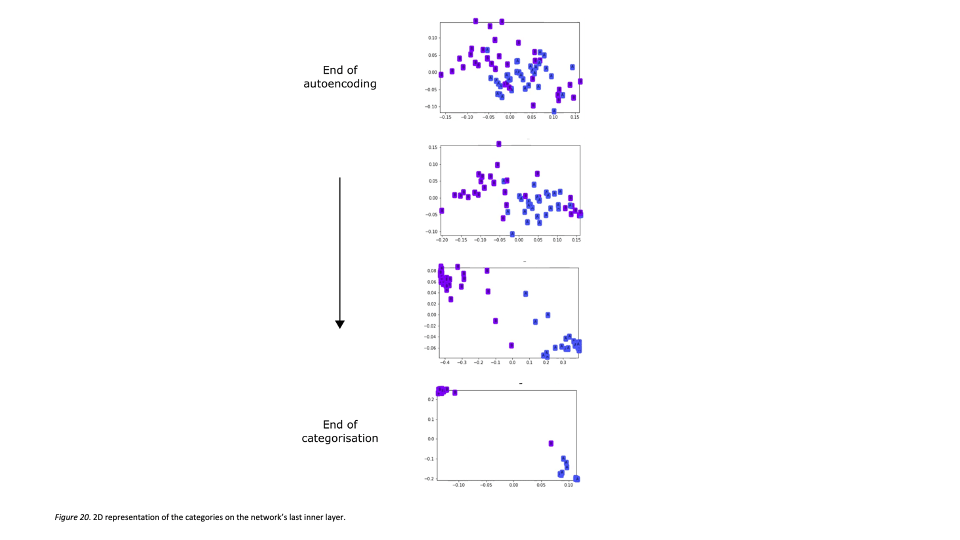
Differences can be perceived as gradual and quantitative, as with different shades of gray, or they can be perceived as more abrupt and qualitative, as with different colors. The first is called continuous perception and the second categorical perception. Categorical perception (CP) can be inborn or can be induced by learning. Formerly thought to be peculiar to speech and color perception, CP turns out to be far more general, and may be related to how the neural networks in our brains detect the features that allow us to sort the things in the world into their proper categories, "warping" perceived similarities and differences so as to compress some things into the same category and separate others into different categories.


Pérez-Gay Juárez, F., Sicotte, T., Thériault, C., & Harnad, S. (2019). Category learning can alter perception and its neural correlates. PloS One, 14(12), e0226000.

Pullum, G. K. (1989). The great Eskimo vocabulary hoax. Natural Language & Linguistic Theory, 275-281.

Tuesday, September 13, 2022

7a. Lewis et al (2017) Evolutionary Psychology

7a. Lewis, D. M., Al-Shawaf, L., Conroy-Beam, D., Asao, K., & Buss, D. M. (2017). Evolutionary psychology: A how-to guide. American Psychologist, 72(4), 353-373.

Researchers in the social and behavioral sciences are increasingly using evolutionary insights to test novel hypotheses about human psychology. Because evolutionary perspectives are relatively new to psychology and most researchers do not receive formal training in this endeavor, there remains ambiguity about “best practices” for implementing evolutionary principles. This article provides researchers with a practical guide for using evolutionary perspectives in their research programs and for avoiding common pitfalls in doing so. We outline essential elements of an evolutionarily informed research program at 3 central phases: (a) generating testable hypotheses, (b) testing empirical predictions, and (c) interpreting results. We elaborate key conceptual tools, including task analysis, psychological mecha- nisms, design features, universality, and cost-benefit analysis. Researchers can use these tools to generate hypotheses about universal psychological mechanisms, social and cultural inputs that amplify or attenuate the activation of these mechanisms, and cross-culturally variable behavior that these mechanisms can produce. We hope that this guide inspires theoretically and methodologically rigorous research that more cogently integrates knowledge from the psychological and life sciences. 


Monday, September 12, 2022

7b. Cauchoix, M., & Chaine, A. S. (2016). How can we study the evolution of animal minds?

7b. Cauchoix, M., & Chaine, A. S. (2016). How can we study the evolution of animal minds? Frontiers in Psychology, 7, 358.


During the last 50 years, comparative cognition and neurosciences have improved our understanding of animal minds while evolutionary ecology has revealed how selection acts on traits through evolutionary time. We describe how cognition can be subject to natural selection like any other biological trait and how this evolutionary approach can be used to understand the evolution of animal cognition. We recount how comparative and fitness methods have been used to understand the evolution of cognition and outline how these approaches could extend our understanding of cognition. The fitness approach, in particular, offers unprecedented opportunities to study the evolutionary mechanisms responsible for variation in cognition within species and could allow us to investigate both proximate (i.e., neural and developmental) and ultimate (i.e., ecological and evolutionary) underpinnings of animal cognition together. We highlight recent studies that have successfully shown that cognitive traits can be under selection, in particular by linking individual variation in cognition to fitness. To bridge the gap between cognitive variation and fitness consequences and to better understand why and how selection can occur on cognition, we end this review by proposing a more integrative approach to study contemporary selection on cognitive traits combining socio-ecological data, minimally invasive neuroscience methods and measurement of ecologically relevant behaviors linked to fitness. Our overall goal in this review is to build a bridge between cognitive neuroscientists and evolutionary biologists, illustrate how their research could be complementary, and encourage evolutionary ecologists to include explicit attention to cognitive processes in their studies of behavior.

Sunday, September 11, 2022

8a. Pinker, S. & Bloom, P. (1990). Natural language and natural selection

Pinker, S. & Bloom, P. (1990). Natural language and natural selection. Behavioral and Brain Sciences13(4): 707-784. 

Many people have argued that the evolution of the human language faculty cannot be explained by Darwinian natural selection. Chomsky and Gould have suggested that language may have evolved as the by‐product of selection for other abilities or as a consequence of as‐yet unknown laws of growth and form. Others have argued that a biological specialization for grammar is incompatible with every tenet of Darwinian theory ‐‐ that it shows no genetic variation, could not exist in any intermediate forms, confers no selective advantage, and would require more evolutionary time and genomic space than is available. We examine these arguments and show that they depend on inaccurate assumptions about biology or language or both. Evolutionary theory offers clear criteria for when a trait should be attributed to natural selection: complex design for some function, and the absence of alternative processes capable of explaining such complexity. Human language meets this criterion: grammar is a complex mechanism tailored to the transmission of propositional structures through a serial interface. Autonomous and arbitrary grammatical phenomena have been offered as counterexamples to the position that language is an adaptation, but this reasoning is unsound: communication protocols depend on arbitrary conventions that are adaptive as long as they are shared. Consequently, language acquisition in the child should systematically differ from language evolution in the species and attempts to analogize them are misleading. Reviewing other arguments and data, we conclude that there is every reason to believe that a specialization for grammar evolved by a conventional neo‐Darwinian process.

Tomasello, M., & Call, J. (2018). Thirty years of great ape gestures. Animal Cognition, 1-9.

Graham, Kirsty E; Catherine Hobaiter, James Ounsley, Takeshi Furuichi, Richard W. Byrne (2018) Bonobo and chimpanzee gestures overlap extensively in meaning. PLoS Biology


Saturday, September 10, 2022

8b. Blondin Massé et al (2012) Symbol Grounding and the Origin of Language: From Show to Tell

Blondin-Massé, Alexandre; Harnad, Stevan; Picard, Olivier; and St-Louis, Bernard (2013) Symbol Grounding and the Origin of Language: From Show to Tell. In, Lefebvre, Claire; Cohen, Henri; and Comrie, Bernard (eds.) New Perspectives on the Origins of Language. Benjamin

Arbib, M. A. (2018). In support of the role of pantomime in language evolution. Journal of Language Evolution, 3(1), 41-44.

Vincent-Lamarre, Philippe., Blondin Massé, Alexandre, Lopes, Marcus, Lord, Mèlanie, Marcotte, Odile, & Harnad, Stevan (2016). The Latent Structure of Dictionaries.  TopiCS in Cognitive Science  8(3) 625–659  


Organisms’ adaptive success depends on being able to do the right thing with the right kind of thing. This is categorization. Most species can learn categories by direct experience (induction). Only human beings can acquire categories by word of mouth (instruction). Artificial-life simulations show the evolutionary advantage of instruction over induction, human electrophysiology experiments show that the two ways of acquiring categories still share some common features, and graph-theoretic analyses show that dictionaries consist of a core of more concrete words that are learned earlier, from direct experience, and the meanings of the rest of the dictionary can be learned from definition alone, by combining the core words into subject/predicate propositions with truth values. Language began when purposive miming became conventionalized into arbitrary sequences of shared category names describing and defining new categories via propositions.

Friday, September 9, 2022

9a. Pinker, S. Language Acquisition

Pinker, S. Language Acquisition. in L. R. Gleitman, M. Liberman, and D. N. Osherson (Eds.),
An Invitation to Cognitive Science, 2nd Ed. Volume 1: Language. Cambridge, MA: MIT Press.
Alternative sites: 1, 2.


The topic of language acquisition implicate the most profound questions about our understanding of the human mind, and its subject matter, the speech of children, is endlessly fascinating. But the attempt to understand it scientifically is guaranteed to bring on a certain degree of frustration. Languages are complex combinations of elegant principles and historical accidents. We cannot design new ones with independent properties; we are stuck with the confounded ones entrenched in communities. Children, too, were not designed for the benefit of psychologists: their cognitive, social, perceptual, and motor skills are all developing at the same time as their linguistic systems are maturing and their knowledge of a particular language is increasing, and none of their behavior reflects one of these components acting in isolation.
        Given these problems, it may be surprising that we have learned anything about language acquisition at all, but we have. When we have, I believe, it is only because a diverse set of conceptual and methodological tools has been used to trap the elusive answers to our questions: neurobiology, ethology, linguistic theory, naturalistic and experimental child psychology, cognitive psychology, philosophy of induction, theoretical and applied computer science. Language acquisition, then, is one of the best examples of the indispensability of the multidisciplinary approach called cognitive science.

Harnad, S. (2008) Why and How the Problem of the Evolution of Universal Grammar (UG) is Hard. Behavioral and Brain Sciences 31: 524-525

Harnad, S (2014) Chomsky's Universe. -- L'Univers de Chomsky. À babord: Revue sociale es politique 52.

Thursday, September 8, 2022

9b. Pullum, G.K. & Scholz BC (2002) Empirical assessment of stimulus poverty arguments

Pullum, G.K. & Scholz BC (2002) Empirical assessment of stimulus poverty arguments. Linguistic Review 19: 9-50 


This article examines a type of argument for linguistic nativism that takes the following form: (i) a fact about some natural language is exhibited that al- legedly could not be learned from experience without access to a certain kind of (positive) data; (ii) it is claimed that data of the type in question are not found in normal linguistic experience; hence (iii) it is concluded that people cannot be learning the language from mere exposure to language use. We ana- lyze the components of this sort of argument carefully, and examine four exem- plars, none of which hold up. We conclude that linguists have some additional work to do if they wish to sustain their claims about having provided support for linguistic nativism, and we offer some reasons for thinking that the relevant kind of future work on this issue is likely to further undermine the linguistic nativist position. 

Only for the stout-hearted:

Everaert, M. B., Huybregts, M. A., Chomsky, N., Berwick, R. C., & Bolhuis, J. J. (2015). Structures, not strings: linguistics as part of the cognitive sciences. Trends in Cognitive Sciences, 19(12), 729-743.

(And a critique, but is it valid?): 

Dąbrowska, E. (2015). What exactly is Universal Grammar, and has anyone seen it? Frontiers in Psychology, 6, 852.

Wednesday, September 7, 2022

10a. Dennett, D. (unpublished) The fantasy of first-person science


Extra optional readings:
Harnad, S. (2011) Minds, Brains and Turing. Consciousness Online 3.
Harnad, S. (2014) Animal pain and human pleasure: ethical dilemmas outside the classroom. LSE Impact Blog 6/13 June 13 2014


Dennett, D. (unpublished) The fantasy of first-person science. 
"I find it ironic that while Chalmers has made something of a mission of trying to convince scientists that they must abandon 3rd-person science for 1st-person science, when asked to recommend some avenues to explore, he falls back on the very work that I showcased in my account of how to study human consciousness empirically from the 3rd-person point of view. Moreover, it is telling that none of the work on consciousness that he has mentioned favorably addresses his so-called Hard Problem in any fashion; it is all concerned, quite appropriately, with what he insists on calling the easy problems. First-person science of consciousness is a discipline with no methods, no data, no results, no future, no promise. It will remain a fantasy."
Click here -->Dan Dennett's Video
Note: Use Safari or Firefox to view; 
does not work on Chrome

Week 10 overview:


and also this (from week 10 of the very first year this course was given, 2011): 

Reminder: The Turing Test Hierarchy of Reverse Engineering Candidates

t1: a candidate that can do something a human can do

T2: a reverse-engineered candidate that can do anything a human can do verbally, indistinguishably from a human, to a human, for a lifetime

T3: a reverse-engineered candidate that can do anything a human can do verbally as well as robotically, in the external world, indistinguishably from a human, to a human, for a lifetime

T4: a reverse-engineered candidate that can do anything a human can do verbally as well as robotically, in the external world, and also internally (i.e., neurologically), indistinguishably from a human, to a human, for a lifetime

T5: a real human

(The distinction between T4 and T5 is fuzzy because the boundary between synthetic and biological neural function is fuzzy.)  

Tuesday, September 6, 2022

10b. Harnad, S. (unpublished) On Dennett on Consciousness: The Mind/Body Problem is the Feeling/Function Problem

Harnad, S. (unpublished) On Dennett on Consciousness: The Mind/Body Problem is the Feeling/Function Problem. 

The mind/body problem is the feeling/function problem (Harnad 2001). The only way to "solve" it is to provide a causal/functional explanation of how and why we feel...


Click here to view --> HARNAD VIDEO
Note: Use Safari or Firefox to view; 
does not work on Chrome


Monday, September 5, 2022

10c. Harnad, S. (2012) Alan Turing and the “hard” and “easy” problem of cognition: doing and feeling.æ

Harnad, S. (2012) Alan Turing and the “hard” and “easy” problem of cognition: doing and feeling. [in special issue: Turing Year 2012] Turing100: Essays in Honour of Centenary Turing Year 2012, Summer Issue


The "easy" problem of cognitive science is explaining how and why we can do what we can do. The "hard" problem is explaining how and why we feel. Turing's methodology for cognitive science (the Turing Test) is based on doing: Design a model that can do anything a human can do, indistinguishably from a human, to a human, and you have explained cognition. Searle has shown that the successful model cannot be solely computational. Sensory-motor robotic capacities are necessary to ground some, at least, of the model's words, in what the robot can do with the things in the world that the words are about. But even grounding is not enough to guarantee that -- nor to explain how and why -- the model feels (if it does). That problem is much harder to solve (and perhaps insoluble).

Sunday, September 4, 2022

11a. Key, Brian (2016) Why fish do not feel pain.

Key, Brian (2016) Why fish do not feel pain. Animal Sentience 3(1) (after reading the article,  read the abstracts of some of the commentaries too, for contrary vuews).

Only humans can report feeling pain. In contrast, pain in animals is typically inferred on the basis of nonverbal behaviour. Unfortunately, these behavioural data can be problematic when the reliability and validity of the behavioural tests are questionable. The thesis proposed here is based on the bioengineering principle that structure determines function. Basic functional homologies can be mapped to structural homologies across a broad spectrum of vertebrate species. For example, olfaction depends on olfactory glomeruli in the olfactory bulbs of the forebrain, visual orientation responses depend on the laminated optic tectum in the midbrain, and locomotion depends on pattern generators in the spinal cord throughout vertebrate phylogeny, from fish to humans. Here I delineate the region of the human brain that is directly responsible for feeling painful stimuli. The principal structural features of this region are identified and then used as biomarkers to infer whether fish are, at least, anatomically capable of feeling pain. Using this strategy, I conclude that fish lack the necessary neurocytoarchitecture, microcircuitry, and structural connectivity for the neural processing required for feeling pain.


Saturday, September 3, 2022

11b. Harnad, S (2016) Animal sentience: The other-minds problem

Harnad, S (2016) Animal sentience: The other-minds problem. Animal Sentience 1(1)

The only feelings we can feel are our own. When it comes to the feelings of others, we can only infer them, based on their behavior — unless they tell us. This is the “other-minds problem.” Within our own species, thanks to language, this problem arises only for states in which people cannot speak (infancy, aphasia, sleep, anaesthesia, coma). Our species also has a uniquely powerful empathic or “mind-reading” capacity: We can (sometimes) perceive from the behavior of others when they are in states like our own. Our inferences have also been systematized and operationalized in biobehavioral science and supplemented by cognitive neuroimagery. Together, these make the other-minds problem within our own species a relatively minor one. But we cohabit the planet with other species, most of them very different from our own, and none of them able to talk. Inferring whether and what they feel is important not only for scientific but also for ethical reasons, because where feelings are felt, they can also be hurt. As animals are at long last beginning to be accorded legal status and protection as sentient beings, our new journal Animal Sentience, will be devoted to exploring in depth what, how and why organisms feel. Individual “target articles” (and sometimes précis of books) addressing different species’ sentient and cognitive capacities will each be accorded “open peer commentary,” consisting of multiple shorter articles, both invited and freely submitted ones, by specialists from many disciplines, each elaborating, applying, supplementing or criticizing the content of the target article, along with responses from the target author(s). The members of the nonhuman species under discussion will not be able to join in the conversation, but their spokesmen and advocates, the specialists who know them best, will. The inaugural issue launches with the all-important question (for fish) of whether fish can feel pain.

Friday, September 2, 2022

11c. Bekoff, M., & Harnad, S. (2015). Doing the Right Thing + Wiebers & Feigin (2020) What the COVID-19 crisis is telling humanity

Bekoff, M., & Harnad, S. (2015). Doing the Right Thing: An Interview With Stevan Harnad. Psychology Today.

Twelve years after stepping down from the editorship of BBS I have accepted an invitation from the Humane Society of the United States to serve as editor in chief of Animal Sentience, a new journal just about to be launched that is devoted to understanding and protecting the feelings of other species. I hope the findings reported in this journal will help inspire us to “do the right thing to the right kind of thing” so that we can at last put an end to the greatest moral shame of our own species – and the greatest agony of all the others. 

Leadbeater, Simon (2019) In Defence of Tears. Ecological Citizen.

Wiebers, David and Feigin, Valery (2020) What the COVID-19 crisis is telling humanity. Animal Sentience 30(1)
 
Summary: The planet is in a global health emergency exacting enormous medical and economic tolls. It is imperative for us as a society and species to focus and reflect deeply upon what this and other related human health crises are telling us about our role in these increasingly frequent events and about what we can do to prevent them in the future. 
Cause: It is human behavior that is largely responsible for the alarming increase in lethal zoonotic diseases that jump the species barrier from animals to humans: (1) hunting, capture, and sale of wild animals for human consumption, particularly in live-animal markets; (2) massive overcrowding of animals for human consumption in stressful and unhygienic industrial “factory farm” environments, a major direct cause of new disease outbreaks and mounting antibiotic resistance; (3) vast numbers of wildlife species threatened with extinction from habitat destruction and incursion. 
Action: The trade and consumption of wild animals in live-animal markets should be banned in all countries. Intensive confinement of animals in factory farm operations should be discontinued worldwide for the sake of animals, humans, and the environment, and we should rapidly evolve to eating other forms of protein that are safer for humans. Additional investment in plant-based agriculture to grow crops to feed humans rather than livestock for human consumption will feed more people while utilizing far less land and water, allowing for the preservation of vital ecosystems for innumerable species. 
Each of us can have a positive impact, beginning with mindfulness about what we eat and how all of our daily choices and actions may be affecting animals and natural habitats. Rather than simply attempting to react to crises like COVID-19 after death and destruction are already upon us, we need to address underlying causes and act now to prevent future disasters. 

Videos from 2018 Summer School on Animal Sentience and Cognition 


PSYC 538 Syllabus

Categorization, Communication and Consciousness 2022 Time : FRIDAYS 8:30-11:25  Place : BIRKS 203 Instructor : Stevan Harnad Office : Zoom E...